
Entry #1 - What is a Set-up?
A set-up is the process of optimizing the playability of a guitar. There is endless information online about how to do a set-up, what the “right” way is to do it, and companies showing you how to do something so they can sell you their product. There’s never been a better time to learn how to work on your own guitar but that is not the point of this blog post.
There are three pillars to a set-up:
Neck relief
String height
String length compensation, often referred to as “intonation”
While these three things are essential to a set-up, there are often other issues which need to be addressed. After all, the guitar is a system and every aspect of the playability should be considered before the work begins.
Neck Relief
Since the strings move in an elliptical pattern, some amount of curvature to the neck is often required. Along the length of the neck you may have a concave shape (up-bow or forward bow), convex shape (back-bow), or even straight.
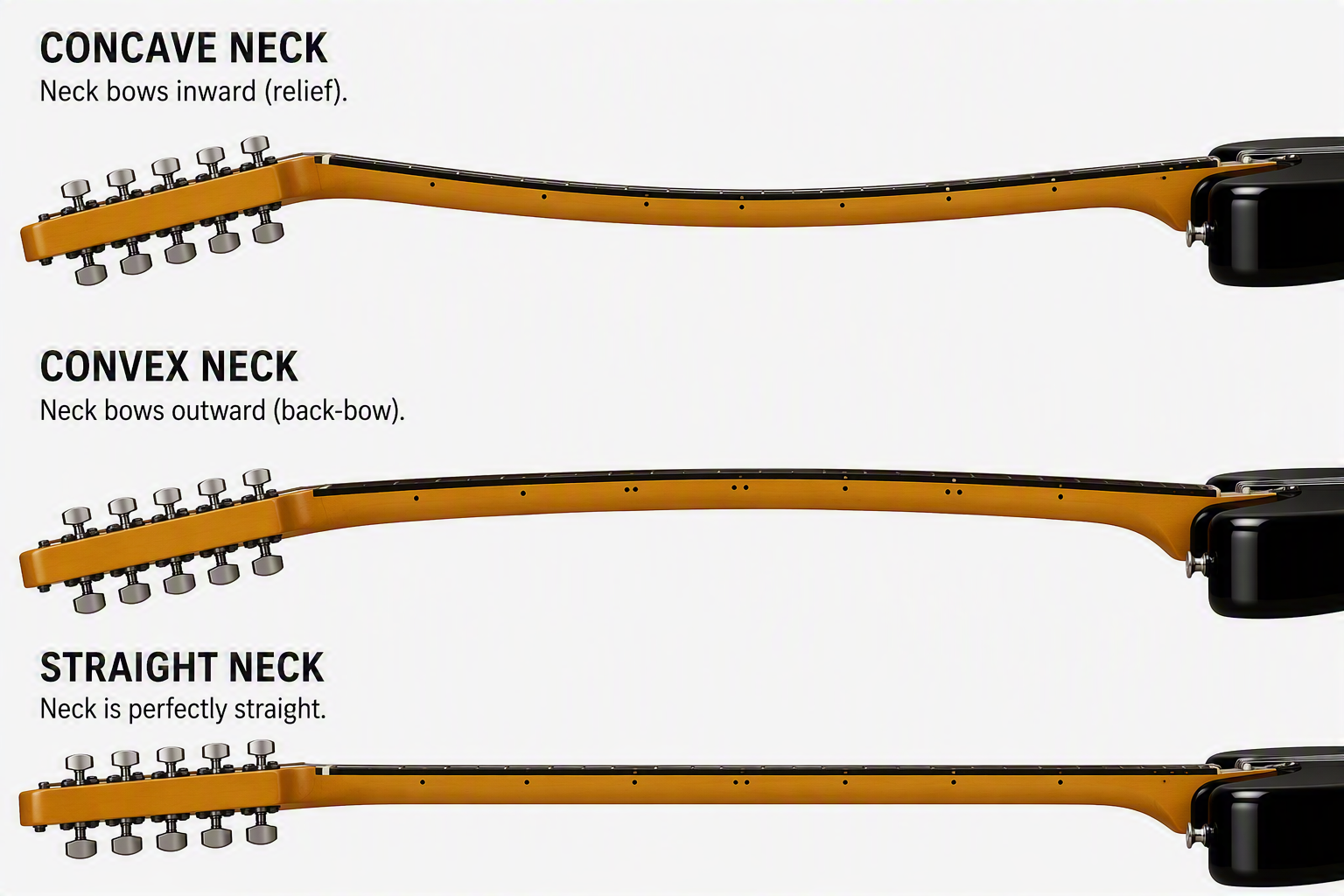
Three basic neck configurations with exaggeration to illustrate the concepts. A “concave” neck with a controlled amount of curvature is what I consider “relief”. If the shape is excessive to a point of causing problems, I would refer to that as a neck with “up-bow”.
A neck can also have an s-curve (high, low, high), a hump at the body, a rise-in-tonge or a twist. Some necks will have more than problem at the same time, which means a simple set-up probably can’t fix the playability.
Most guitars will have a truss rod which (hopefully) controls the neck how we want it to be.. Unfortunately, it is not uncommon to find a truss rod which is damaged, or maxed out. Without inspecting the instrument and getting a wrench on it, we can’t tell how well it works.
String Height
String height is often referred to as the “action” and it is the height of the strings above the fingerboard or frets. Despite what you may have heard on the internet, there is no “right” measurement to shoot for. An acoustic guitar might have slightly higher action than an electric. A player that uses a slide might want higher action compared to someone who never plays slide.
The right action is comfortable for the player without causing excessive fret buzz. Why do I say “excessive” fret buzz? It is a matter of physics when you have a metal string moving in proximity to metal frets because at some point buzzing may occur. When it comes to a set-up, we are at the mercy of how well the fingerboard has been prepared and how well the frets have been leveled. This is another limitation to a set-up. The end result is only as good as the fret job. Over time playing the guitar wears the frets and alters the shape. Unless the shop always require the frets be leveled and crowned, a fret dress is usually an additional cost and a fret dress is not the same as polishing the frets.
Even with a high quality guitar with a high quality fret job, over time with seasonal changes frets can pop loose and cause problems.
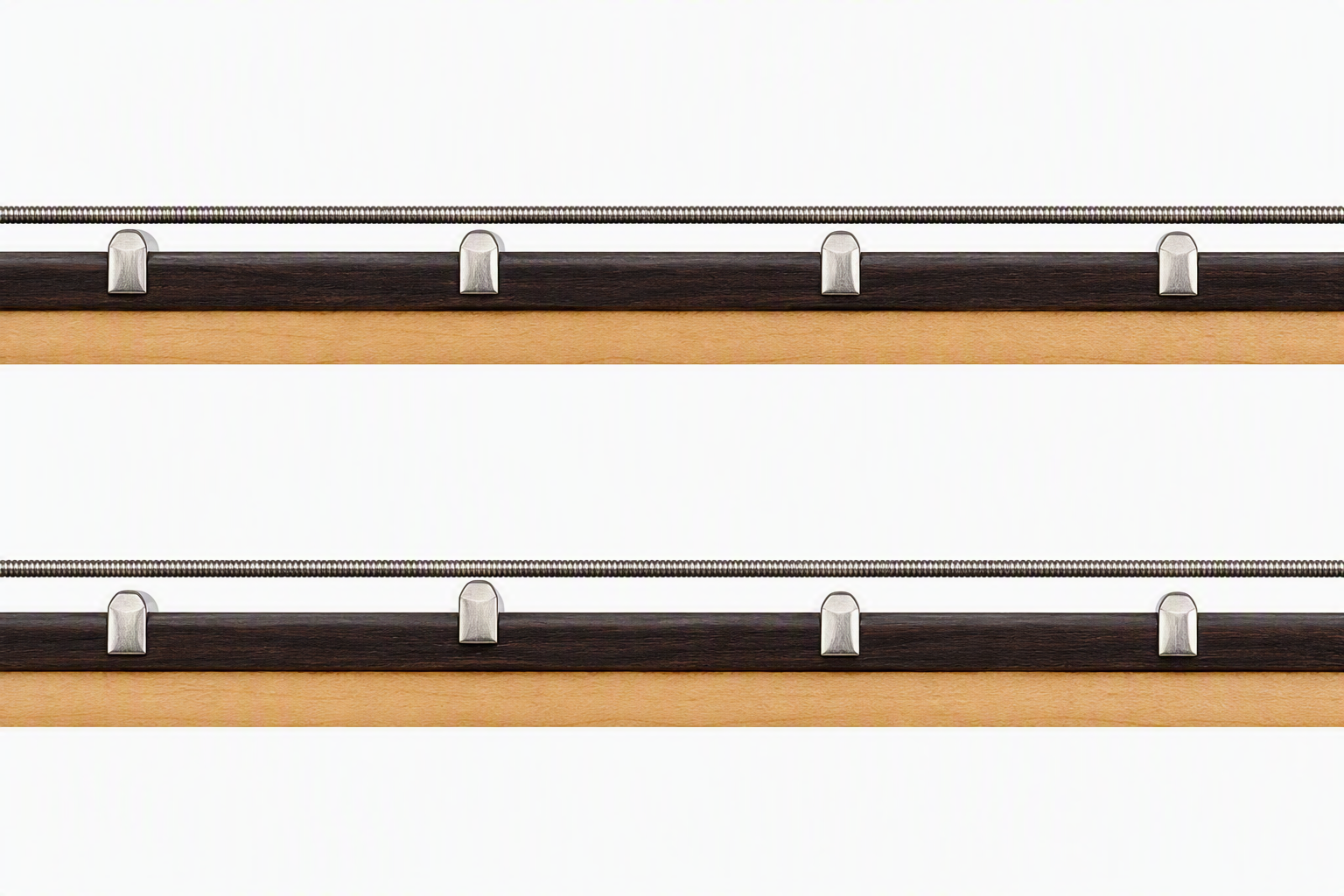
It is not unusual for frets to work loose over time. A loose fret can cause fret buzz in a specific area while many loose frets can cause buzzing all over the neck. Whenever I find more than three loose frets on a guitar, every fret gets glued down which adds about 30 minutes to a set-up.
Cowboy Chords!
We might be thinking of string height above the fingerboard at the 12th fret or perhaps at the neck/body joint but, the nut of the guitar is also critical for playability. The guitar nut establishes the spacing between each string and how close the outer strings are to the edge of the fingerboard. Just as critical will be distance from the bottom of the string to the top of the first fret which is determined by the nut slot depth.
If the nut slots are not cut deep enough, there will be excessive height from string to fret. This requires the player to press harder and it will be uncomfortable or difficult to play which means, the guitar isn’t much fun.
If the nut slots are cut too deep the strings can begin to buzz on the first fret which is also a problem. The difference between too high and too low are surprisingly small. As a matter of fact, a few thousandths of an inch can make or break this reality. I’ve watched many “how-to” videos on guitar repair, demonstrate how to adjust the nut slots. I always wonder how many people watch that video and try it for themselves. However many people actually do, I’d bet most of them cut a slot too low. Why do I think that? Because I’ve taught hundreds of people how to work on guitars and cutting nut slots is one of the easiest things to screw up.
No matter how long you’ve been working on guitars there is the possibility you will cut a slot too low. I can say from experience, making a nut from scratch is a challenge and accidentally cutting a slot too low is excruciating because the correct fix is to make a new nut from scratch. And no one is paying you to repeat the process so you instantly cut your earnings in half with a simple swipe of a file.
String Length Compensation
A vibrating string moves in an elliptical pattern between two “nodes”, the nut (headstock) and saddle (bridge). The approximate length of the vibrating string is determined by the scale length of the instrument. Additional length is needed to get the string to play as close to “in tune” everywhere along the fingerboard. The amount of compensation varies by the mass of the string, the tension of the string, and the length. A longer string requires more tension at a given pitch compared to the same string on a shorter scale length. This is why a set of “.010’s” on a Stratocaster feels different than on a Les Paul.
During a set-up we want to adjust the string length compensation. This adjustment is often referred to as “intonation” or setting the intonation. This is typically easier on an electric guitar compared to an acoustic guitar, which would require a new saddle be made with specific shaping for each string.
When setting intonation it is recommended to use a new set of strings. As strings are played they fatigue and the results of intonation may vary. By setting the intonation with a new set of strings, you will be back to the same point whenever you put on another set of strings, assuming you use the same brand and gauge.
Why does the same brand and gauge of string matter?
Notice I mentioned the “mass” of a string and not the diameter as it relates to string length compensation. That is because you can have the same overall diameter between two guitar strings but the differences in materials and the construction techniques could be different which changes the mass.
While the difference between two string manufactures set of .010” - .046” electric strings might not wildly alter the intonation, it is worth considering. I always emphasize to the customer, the gauge of the string is even more important. If I set the intonation to a set of 10’s and they restring with 9’s or 11’s they’re more likely to have intonation issues.
How often should a guitar have a set-up?
In an ideal world, in which we do not live, once a year is a good idea or with any dramatic change in season. Here in the midwest we can go from hot and humid in the summer to very cold an extremely dry in the winter. Guitars are most often made from wood which expands and contracts with a change in humidity. I’ve even made an extra saddle for acoustic guitars so the player has a taller “winter” saddle and a lower “summer” saddle. Usually some basic adjustments with a change in season will do the trick.
Many players will prefer to do their own set-ups which is fine as long as they have a good understanding of what is involved. I would encourage any guitar player to find a professional to work on their guitar rather than trying something outside of their abilities. I’d say “know your limits” when it comes to DIY guitar work because fixing a mistake is more expensive than fixing it right.
Misplaced confidence can be expensive.
Final Thoughts
If you are reading this and have a guitar you use to enjoy but now it’s collecting dust, consider taking it to a shop for a set-up. You might be shocked at the difference afterwards. If you have never had your guitar worked on, bring it to a shop and have it looked at. I have seen some WILD “before” guitar conditions and after some work, they’ve been transformed.
Just realize the three pillars of a guitar set-up do not fix every situation. Talk to the person who will do the work, trust your instinct when it comes to that interaction, and if you don’t feel good about it, take it somewhere else and try again.
Find someone you trust and give them a chance.
Also, don’t believe anyone in a guitar forum telling you guitar repair people charge too much. It can take years of hard work to get proficient at this work and it’s not the kind of career a person goes into so they can buy a second home or a new Ferrari. We do this work because we love it, find it challenging/rewarding, and want to fix broken things to help our customers.
Images for the blog were created using M365 Copilot AI.